Learn about Texting n
Driving Dangers - TextingnDriving.com is here for your education
and understanding of the dangers associated with texting while
driving. Texting and driving is not
only against the law in 46 states, but can also easily
turn a harmless drive into a nightmare. Just think about it,
what if you looked away for just a moment, and didn't notice that
the car you were driving changed lanes into oncoming traffic. If
you are lucky enough to look up in time and see you were not in your
lane anymore, you could react quick enough to save yourself, and maybe others as well. But far to many people, a near miss
was not their fate. Texting and driving is dangerous. Texting and
driving does kill, and has many many times.
Cell phone found in drivers hand, was the text
worth it? source: Facebook
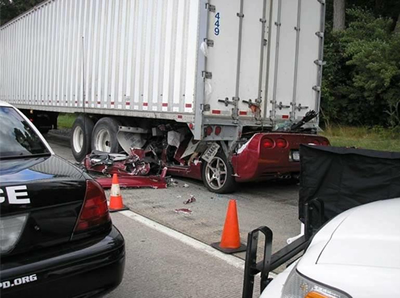
Bus Driver Hit Truck While Texting
Some Startling Facts:
*
80% of crashes, and 65% of near crashes, involved some form of
driver inattention within 3 seconds of the incident.
** 57% of American drivers admit to texting behind the wheel. (I'm
guessing more actually, but some probably didn't want to admit to
texting n driving.)
*** Study: 74% of Americans
admit to distracted driving, 19% using web
**
89% of Americans adults think sending text messages or e-mails while
driving is distracting, dangerous and should be outlawed.
By KOMO
~ Friday, February 05, 2016
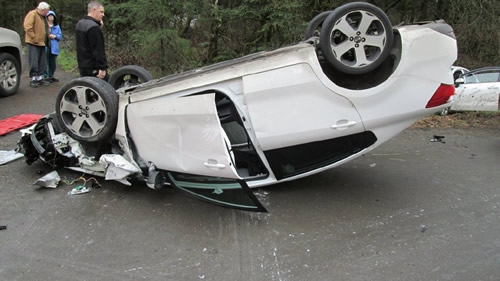
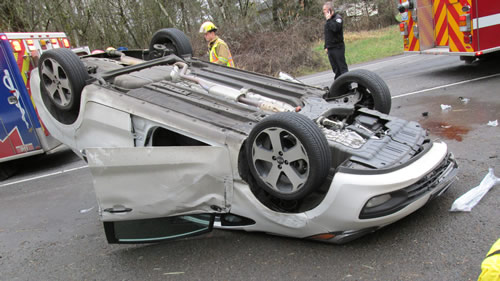
BATTLE GROUND, Wash.(KOMO) -- A 17-year-old girl is now facing
criminal charges after she pulled off a "hat trick" of distractions
while driving along SR-503 in Southwestern Washington Friday
morning. The girl was heading north near milepost 13 outside of
Battle Ground when a car ahead of her slowed to turn into a
driveway. That driver noticed the teen coming up fast behind her and
tried to veer to the right, but her car was struck in the back left
corner. The teen's car was spun around and rolled over, while the
victim's car was knocked into a ditch, according to troopers. The
teen was taken to Legacy Salmon Creek Hospital for treatment of
minor injuries. The victim in the car ahead of her wasn't injured.
Investigators say the teen admitted to troopers she was texting,
using Facetime and Snapchatting while driving. The police report
says the teen will be charged with reckless driving.
Texting-n-driving crackdown
coming July 4th weekend.
Nationwide, 46 states and the district of Columbia ban text
messaging behind the wheel, and many states prohibit texting by
novice drivers.
Washington State Patrol trooper Brandy Kessler checks a driver's
registration before issuing her a $124 ticket for driving while
talking on a cell phone on June 10 in South Hill, Wash.
Drew Perine/AP
Does this look safe? How many times
have
you seen someone, or been part of something
like this? Look at the speedometer, it is about at
70 MPH. Do your part, and don't help to promote
Texting n Driving.
Texting n Driving:
Teenagers Aren't the Only Ones Doing it - Did you think that
only teenagers were irresponsible enough to text message on their
cell phones while driving? With so many options for teens
it's easy to see how kids could easily be considered a high risk for
texting and driving. According to a Pew Research
study, adult drivers are text messaging while driving too. Compare the following statistics for teenage drivers and adult
drivers:
Teens and Cell Phones
75% of American teenagers own cellphones
and 66% of these teens text message.
82% of teens between 16 and 17 have a cell phone.
34% of teens who text message admit to
texting while driving.
48% of teens say they have been a passenger
in a car whose driver was texting.
Adults and Cell Phones 82% of adults have cell phones.
47% of adult cell phone users report
texting while driving.
27% of all adults report texting while driving.
49% of adults report they have been a passenger
in a car when the driver was texting.
44% of adult report they have used a cell phone in a
car in a manner that puts themselves or others at
danger.
17% of adults report bumping into something while
driving when using a cell phone.
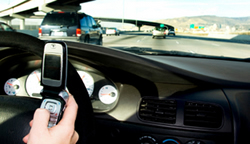
Texting and Driving - A
Simple Explanation - Several states are using the busy
Independence Day weekend to spotlight a dangerous increase in cell
phone use while driving.
Cell phone use - especially texting - has become so ingrained in
society that far too many people ignore laws banning the practice. A
2008 study by the mobile industry’s trade association CTIA found
that among teens ages 13 to 19, 57 percent view their cellphones as
key to their social life, and most view texting as a vital feature.
Yet to mix this activity with driving is statistically extremely
dangerous.
The California Highway Patrol released a report Wednesday showing
that talking on a cell phone while behind the wheel is the leading
factor contributing to crashes blamed on inattentive drivers.
Furthermore, the US Department of Transportation reports that
distracted driving played a role in nearly 6,000 deaths and 500,000
injuries in 2009.
The key to reversing the trend is education about the danger, say
several experts. Physiologically, there are three different kinds of
distraction, say experts: visual (taking eyes off the road), manual
(taking one or more hands off the wheel), and cognitive (mental
attention.) Texting involves all three, which a July 2009 study from
the Virginia Tech Transportation Institute shows increases the risk
of a crash 23.2 times higher than non-distracted driving – higher
than driving while intoxicated.
“That is a recipe for danger,” says Bob Petrancosta, the VP of
Safety for Con-way Freight, a $4.3 billion freight transportation
and logistics services company. “The message needs to be
communicated across society … and if it were really understood,
maybe we would have a chance to stem the problem.”
But cell phone use – particularly texting – has become attitudinal
and built-in, studies show.
The Pew Research Center's Internet & American Life Project reports
that text messaging has become the preferred method of communication
for American teenagers, with one in three teens sending more than
100 texts a day. The same study found that 26 percent of US teens
admit to texting while driving. And the National Safety Council
announced in January of this year that nearly 30 percent of all auto
accidents were primarily caused by using a cell phone while driving.
"We’re now a mobile society," says Chicago attorney Howard Ankin.
"Everyone wants to use their phone while driving and not be stuck
and unproductive in traffic. Most people think the people who get in
accidents while using a cell phone is the other guy, not them," he
says.
“In congested cities across California, where the commuters can
spend hours in traffic, using a cellphone to send a text or email
can seem harmless,” says Reza Torkzadeh, a personal injury lawyer
and author of “Accidents Happen But Who’s Going to Pay the Bills?”
She says studies have shown 8 out of 10 drivers support some type of
restriction or ban on mobile device usage while driving.
Since California's hands-free law took effect two years ago, banning
cell phone use behind the wheel, California has issued an estimated
500,000 tickets to drivers ignoring the law. Nationwide, 28 states
and the district of Columbia ban text messaging behind the wheel,
and nine states prohibit texting by novice drivers. Six new
texting-while-driving bans will go into effect in July.
But many in law enforcement want stronger penalties and deterrents
and more tools for enforcement.
“I would appreciate stricter laws," says Colonel Brendan Doherty of
the Rhode Island State Police. "We need search warrant capability so
when we are researching an accident, we can find out if one or more
of the drivers was texting at the time of the accident," he says.
Rhode Island prohibits texting but not cell phone use, which makes
enforcement problematic, he says.
One bright spot is that there are a host of technological advances
making their way into the marketplace, says experts.
Coinciding with the holiday weekend, Iconosys Inc., a mobile app
maker, has announced several applications that can send automatic
responses to text senders.
“It has become commonplace among youth that when they can’t
immediately text back to a received message, they feel like the
sender will feel ignored,” says Iconosys president Wayne Irving II.
His company's applications – some free – are capable of sending
messages that say, “I’m driving a car now. When I can pull over, I
will call you back.” Some are even cued automatically by satellite
technology that shows when the cell phone is in motion.
“We are trying to develop these for youth who want to be cool but
also don’t want parents and bosses being able to snoop too much over
their shoulders,
says Mr. Irving. By Daniel B. Wood
This is an email sent to me by another concerned
person, about the dangers and epidemic we have called Texting n
Driving...
It
is sad how our government is handling the driving and texting
epidemic. Programs, media, and laws are not correcting or even
putting a dent into the problem. They were showed a simple solution
over a year ago with next to no cost to the public for new and used
vehicles. The DOT and Ray Lahoods people wanted nothing to do with
this solution. As far as I’m concerned they should be responsible
for all accidents and deaths caused from texting and driving. I’m
one person that believes everyone in our federal government that has
anything to do with the epidemic of texting and driving should be
fire and held responsible. The design and product we came up with is
so simple and so complete that it eliminates text and driving 100%
no matter what with no exceptions. Even the FCC liked and approved
our product and design. With our design and product there is no
depending on GPS or movement of the vehicle. The cost of our design
and product is at the most $50.00 per vehicle with no monthly
payments or subscriptions. Once installed no choice and no
exceptions the epidemic is 100% cured. All the other products and
programs out there do not take care of the problem 100% and depends
on choices, exceptions, GPS, and/or additional and monthly costs.
Ours design and product has none of that it just stops texting and
driving in its tracks. How many deaths does it take before our
government gets serious about creating a true solution? When it came
to visibility to SUVs backing up they came up with a solution in no
time at all, so why not texting and driving? If you have any
questions please call (574-261-6539) or email (ld.windwire@yahoo.com)
me.
Sincerely, David Smith
**** Did you know?
• Five seconds is the average time a driver’s eyes are off the road
while texting. When traveling 55 mph, that is enough time to cover
the length of a football field.
• In 2011, at least 23 percent of auto collisions involved cell
phones, equaling 1.3 million crashes.
• At any given daylight moment across America, about 660,000 drivers
are using cell phones or manipulating electronic devices while
driving, a number that has held steady since 2010.
• In 2011, 3,331 people were killed in crashes involving a
distracted driver, compared to 3,267 in 2010. An additional, 387,000
people were injured in motor vehicle crashes involving a distracted
driver, compared to 416,000 injured in 2010.
• A texting driver is 23 times more likely to get into a crash than
a non-texting driver.
• Engaging in visual-manual subtasks (such as reaching for a phone,
dialing and texting) associated with the use of hand-held phones and
other portable devices increased the risk of getting into a crash by
three times.
• Using a cell phone while driving, whether it is handheld or
hands-free, delays a driver’s reactions as much as having a blood
alcohol concentration at the legal limit of .08 percent.
• Forty-eight percent of young drivers have seen parents drive while
talking on a cell phone and 15 percent of young drivers have seen
their parents texting while driving.
• Eleven percent of all drivers under the age of 20 involved in
fatal crashes were reported as distracted at the time of the crash.
This age group has the largest proportion of drivers who were
distracted.
• Sixty percent of drivers use cell phones while driving. Over 60
percent of American teens admit to risky driving, and nearly half of
those also admit to text messaging behind the wheel.
* NHTSA - (National Highway Traffic
Safety Administration) - NHTSA, Virginia Tech Transportation
Institute Release Findings of Breakthrough Research on Real-World
Driver Behavior, Distraction and Crash Factors
** Driving While Texting Statistics -
whocanisue.com
*** Johnston Moore &
Thompson - Attorney at Law - Huntsville personal injury law.
**** www.textinganddrivingsaftey.com;
www.distraction.gov; University of Utah; 2011 Harris Poll

 Nationwide, 46 states and the district of Columbia ban text
messaging behind the wheel, and many states prohibit texting by
novice drivers.
Nationwide, 46 states and the district of Columbia ban text
messaging behind the wheel, and many states prohibit texting by
novice drivers. 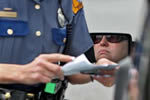 Washington State Patrol trooper Brandy Kessler checks a driver's
registration before issuing her a $124 ticket for driving while
talking on a cell phone on June 10 in South Hill, Wash.
Drew Perine/AP
Washington State Patrol trooper Brandy Kessler checks a driver's
registration before issuing her a $124 ticket for driving while
talking on a cell phone on June 10 in South Hill, Wash.
Drew Perine/AP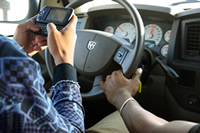
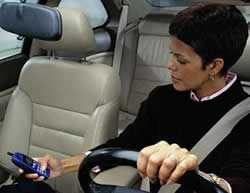
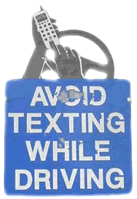 Texting and Driving - A
Simple Explanation - Several states are using the busy
Independence Day weekend to spotlight a dangerous increase in cell
phone use while driving.
Texting and Driving - A
Simple Explanation - Several states are using the busy
Independence Day weekend to spotlight a dangerous increase in cell
phone use while driving.